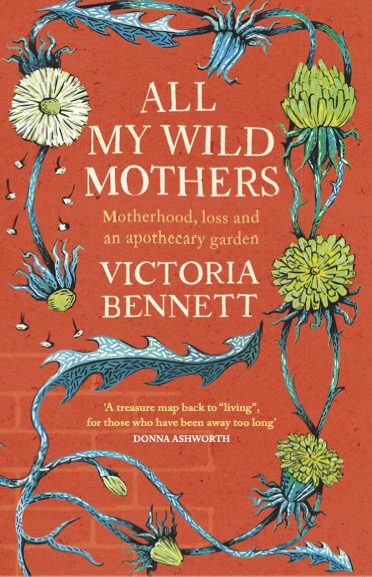
What are you reading my lovelies? Continuing to share books and writers I love, let me introduce the wonderful Vik Bennett and her memoir. I loved this book so much, an exploration of grief and motherhood and the making of something wild and magical to heal and grow. More than a book about gardening, this is the story of a woman learning to live in the world with her grief.
About Vik
Victoria Bennett is an award-winning disabled writer, creative facilitator, and literary activist. Her creative practice spans poetry, memoir and digital storytelling, with a focus on nature, identity, and creative resilience. Her debut memoir, All My Wild Mothers: Motherhood, Loss and an Apothecary Garden (John Murray Press, 2023), was recognised with the Nautilus Award for Memoir (2024) and selected as an Aladin ‘Best Book of the 21st Century’. It received the Northern Debut Award for Narrative Non-Fiction, was shortlisted for the Lakeland Book of the Year and The People’s Book Prize and longlisted for the Nan Shepherd Prize for Nature Writing. Her poetry has previously won the Northern Promise Award, Andrew Waterhouse Award and she is a Millennium Awards Fellow for her work in highlighting positive mental health through poetry.
As the founder of Wild Women Press (1999) and the Wild Women Writers’ Salons (2023), she has worked to support underrepresented voices, ensuring that literature remains a space of inclusion, discovery and empowerment, championing community-driven literary initiatives that amplify voices and foster connection.
She lives and works in Orkney with her husband, artist Adam Clarke, and their son. When not juggling writing, caregiving and chronic illness, she can be found where the wild things are, tending her apothecary garden.
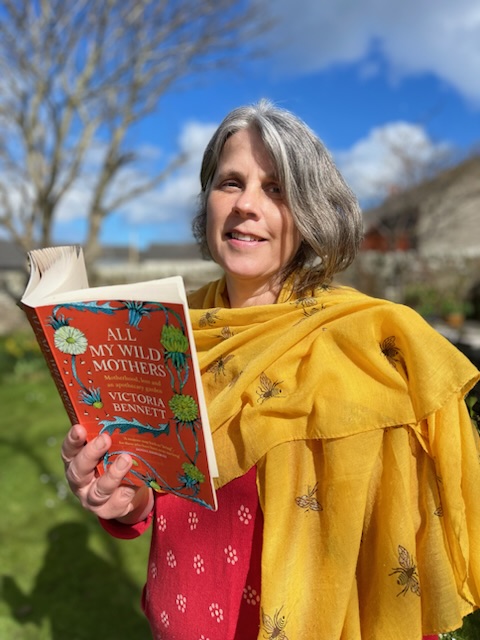
Can you tell us a little about the book?
I wrote All My Wild Mothers over the period of 10 years, in the moments between the demands of caregiving and grief. During this time, my young son and I grew an apothecary garden on the social housing estate where we lived, learning all about the healing properties and folklore of weeds and wildflowers that grew around us. We had no money, so everything we used was reclaimed, recycled, rescued or repurposed, and the plants that we grew were mostly the ones that other people called weeds — nettle, oxeye daisy, cleavers, plantago. The memoir begins with my sister’s accidental death in a canoeing accident and ends with me nursing my mother through terminal cancer at the end of her life, and yet it is not a story of sadness but of hope.
Why did you write this book?
Life goes by so very fast. My sister died two months before my son was born. I was trying to live with grief and be a mother to my little son. I was painfully aware that in that grief, I was only part present and I didn’t want to stay that way. I wanted to capture the small moments that make life both beautiful and terrible, and to learn to live fully in both. By letting myself get close to what was wonderful and what was hard, I came to understand the wonder in both. Once I saw that in my writing, I wanted to share that with others. Grief is not something that we get over but something we live alongside, and to offer others hope that when things feel most broken, life can still hold wonder. The subtitle is Motherhood, Loss and an Apothecary Garden but in many ways, it is a story of what it is to care — for ourselves, for each other, for the planet we call home. It is as much a celebration of love as it is a story of loss.
How has writing a memoir impacted or changed your life?
As someone who had written poetry for most of my life, I genuinely thought I had run out of words at the end of it — but thankfully, that isn’t the case. The process of writing and editing gave me a deeper understanding and empathy towards myself and others. It has also introduced me to a lot of lovely people, and inspired me to set up the Wild Women Writers’ Salons, dedicating the first year of events to celebrating writers of memoir and non-fiction.
How did you balance the need to be honest and authentic, with the need to protect the privacy of yourself and others in your memoir?
I think this comes with the writing and editing. I wrote the memoir over a long time, which also gave me a chance to grow with it — beginning it when my son was very small and publishing it when he was in his teens. Taking time helped shape the book that it became because my experiences changed. I have a rule — write it down, then read it — if it is coming only from anger or pain, sit with it a while.
As I was writing about people who had died and obviously also about my young son, I felt a responsibility to make sure that what I wrote was written out of love and kindness, and would be respectful of the fact that I was telling a story that they could not tell — either because they were no longer alive, or because they had not yet lived enough years to tell it.
I wrote purposefully as close to the truth as I could, to the moment of experience, to be as authentic and honest as possible. To protect the privacy of others and myself, especially those closest, I offered the opportunity to read the final draft, and weighed up the importance of inclusion where they wanted any edits made. I also decided not to name anyone in the book.
Can you tell us a little about your writing practice?
It is a bit haphazard — I write when I can, where I can, and how I can. Sometimes, this is more, sometimes less. I try to make the space sacrosanct whilst I have it — for however long — by lighting a candle. I write long hand and also straight to computer, depending on which feels right or where I am. I tend to have a huge stack of books, and way too many tabs open, and a proliferation of Post-It notes stuck on every surface.
When did you first start writing?
My first poem was about my father dying and his ghost revisiting me in my sleep. He wasn’t dead, and I was five. I think the writing was on the wall then! I honestly can’t remember a time when I didn’t write.
What advice would you give to aspiring writers?
Write what you want to write, tell the story you want to tell. Most writers have two or three big questions they are trying to work out — try to understand yours. It’s okay to revisit the same questions over and over in different guises! Be truthful to yourself but don’t punish yourself. You don’t owe anyone more of the story than you want to tell. Don’t be afraid of writing outside the box, and don’t worry about scarcity. There is enough creativity to go round — share your ideas, your passions, your joy. Find your tribe. Keep going. Celebrate it all — life is writing in progress, even if your pen isn’t on the page. Remember that writing hasn’t got an end goal – agent, publication, awards — they all help but they aren’t the reason for it. It is all a quest — say yes, every time. Unless you don’t want to. In which case, you can take a break too!
Do you ever get feedback from readers and what do they say?
We write for ourselves, but we publish for others. It is always wonderful to receive messages from readers, to know that my story has reached someone else. In this age of divisiveness, to be part of something that helps us connect feels very precious.
Did you have a favourite book as a child?
Totally predictable — it would be a toss up between Little Women (there were four sisters in my family and yes, I was Jo), The Secret Garden (of course), and the Narnia stories (I blame my mother’s wardrobe and collection of secondhand moth-eaten fur coats, that she never wore but thought throwing away was disrespectful to the animals who’d died).
What are you reading now?
Far too much. I have just had an amazing retreat at the Moniack Moor Writing Centre, so I’ve been reading across lots of books. My current bedside read is The Mourner’s Bestiary by Eiren Caffall, which is a gorgeous and important book — and I am thrilled to be welcoming Eiren to the Wild Women Writers’ Salons next season.
Are you a member of your local Library ?
Definitely — where else could I go and pick up a 1914 copy of a botanist’s herbarium, a book on renewable energy research in Orkney, a dictionary of Orcadian dialect, and a Mediterranean cookbook, all ready for me to take away? Libraries are brilliant resources and should be protected.
What are you working on now?
It is an exciting time but I sometimes forget where I left myself as I run past, and I have to remind myself that even chronically ill superheroes need to rest once in a while, so I’ve been taking it slow (for me) for the first half of the year.
That said, I am putting together the 2025-26 programme of Wild Women Writers’ Salons, with the mind-boggling amount of organisational prep that goes into bringing together over 50 authors from around the world and coordinating them across time, genre, themes, and inspirations. I am also working on a new book — more news on that very soon — and something else is bubbling in the cauldron too, which has been a long time brewing.
A big thank you to Vik for taking the time to answer my questions. You can follow her here. www.victoriabennett.me
Instagram @Beewyld Bluesky / @beewyld.bsky.social
https://wildwomansalons.substack.com/
All My Wild Mothers is available to buy in hardback and paperback online in all the usual places, and in all good bookshops. Viks preferred bookshop is https://www.samreadbooks.co.uk/product/victoria-bennett-all-my-wild-mothers/11664
It is also available in Kindle and audio version.
At the moment, the entire programme of Wild Women Writers’ Salons is available to view for free through subscribing to the newsletter. The new programme will be beginning in June, with information going out in the newsletter — so do subscribe!
 Bordering Grey
I’ll be sure to add this to my to read list, thanks for the fascinating interview.
LikeLiked by 1 person
It was a pleasure to chat to Vik, she was very generous with her time ❤️
LikeLiked by 1 person