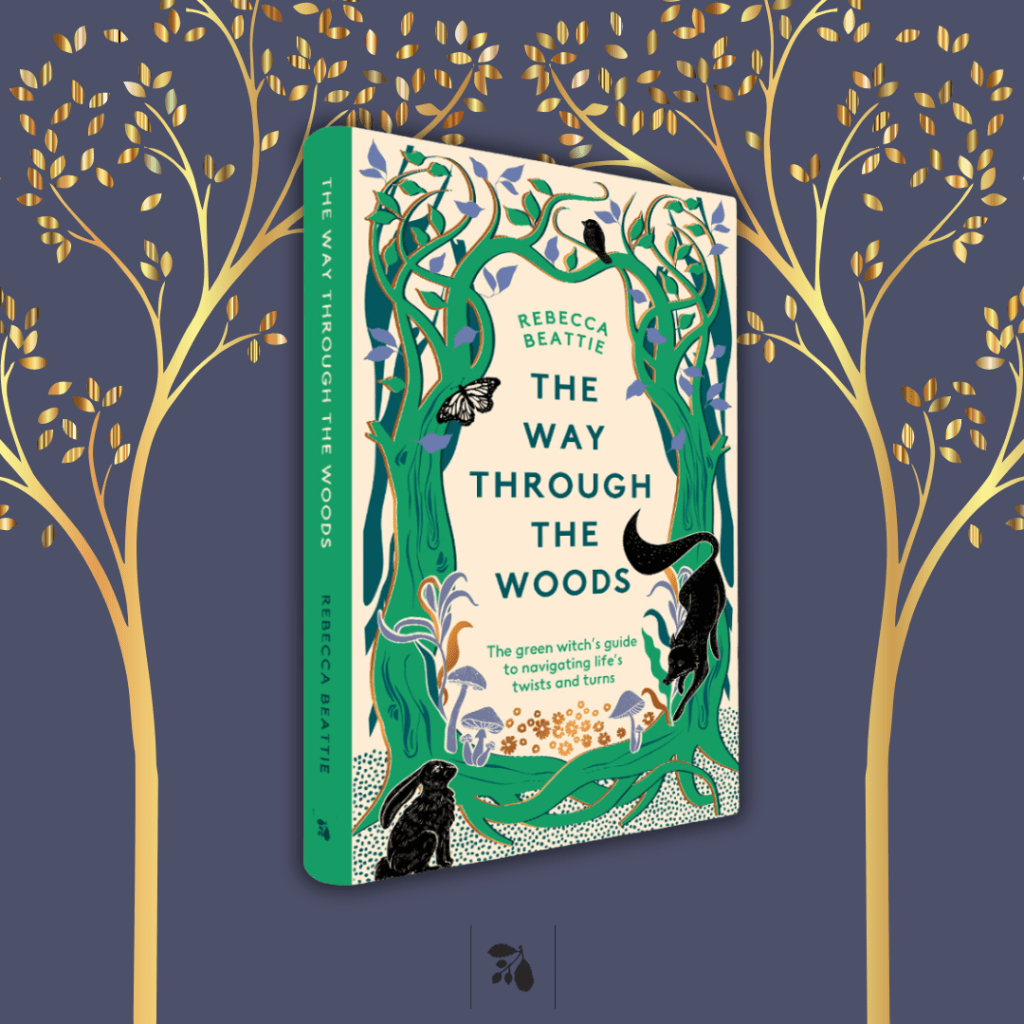
This month, we’re talking to Rebecca Beattie about her writing practice. I have loved reading The Way Through The Woods: A green witch’s guide to navigating life’s ups and downs. Immersed in nature, this is a deeply nourishing read, full of compassion, wisdom, and rituals for meeting life’s challenges. I know a few of you will be especially interested in this book – expect it as your birthday gift. For me, I loved the down-to-earth nature of Rebecca’s writing, which has sparked a reconnection with my own solitary practice. Thank you, Rebecca
Rebecca Beattie has spent over two decades studying and practising witchcraft. A Wiccan priestess of 21 years and a solitary witch for 26, she has a rich understanding of the history and traditions underpinning pagan practice. She also has a doctorate in Creative Writing and is a published author. Her books include Wheel of the Year: A Nurturing Guide and the new pagan toolkit for navigating major life changes, The Way Through the Woods.

Can you tell us a little about the book?
The Way Through The Woods: A green witch’s guide to navigating life’s ups and downs really does what it says on the tin. It covers the four seasons of the year, and explores some of life’s most difficult challenges, using nature as our map, compass and tour guide. I’ve divided the challenges into ‘seasons’ as they can often evoke the turning of the year – for example, in winter I have journeyed through grief, the loss of a relationship, in Spring I have navigated the beginning of a new relationship, and surviving and thriving family dynamics, Summer brings us finding our flow and our sense of belonging, and autumn takes us to menopause and self-actualisation.
Why did you write this book?
The book came about during a lunchtime chat with my commissioning editor and the PR guru and my publishers. We were getting ready to promote my first book with them – The Wheel of the Year – and we got chatting about all the changes I had experienced in life in the last decade or two – from the loss of my mother, to divorce, to really finding my place in the world, and my editor suddenly said, ‘that would make an interesting book’. We went from there. Ironically, I thought I was done with life changes, but its almost as if the universe has said, ‘Think you know about this stuff, do you? Let’s try you with this…’ The truth is, life never stops changing, and each time we face a new challenge we feel like a beginner again.
When did you first start writing?
I started writing during my first Saturn Return – at the end of my twenties. My life had just exploded in a shower of sh!t – I had ended a significant relationship, and also ended a career I had been working up to since the age of about seven years old (acting). I realised acting was making me miserable, as it was a world that was full of people willing to take advantage of your hunger to get somewhere. I realised it was making me very jaded, so I took a year off acting, left my then-fiancé, and decided I would set out on a quest to find something more meaningful. First came a spiritual life – I started exploring paganism in earnest, and studying witchcraft under a more experienced teacher, and along the way I was encouraged to explore some folklore that caught my attention. I looked homewards to Dartmoor (where I grew up) for inspiration, and started writing a short story, which kept growing until it became my first novel. I realise writing had a massive advantage over acting, as I was able to be creative on my own terms – I wasn’t waiting for someone else to offer me a role in order to get my creative energy flowing – it was up to me. It has stayed with me ever since.
How has writing impacted or changed your life?
Writing has changed my life completely, and it’s been my constant companion through some really tough trials. I kept writing fiction for quite a few years, and was doing the great ‘agent hunt’ for a long time. I think I wrote about three novels and a book of short stories – each of which got rejected whenever I sent them out. In the end I decided I needed to really study more formally to get better at writing, and in a roundabout way of doing this, I started with a part time MA in Modern and Contemporary literature that I studied in the evenings after work, followed by a PhD. It wasn’t all straightforward. My first attempt at a PhD failed (it was lit crit) as the university I was at struggled to place me and my subject (the nature mystic 1920’s novelist and poet, Mary Webb) with the right supervisor. Neither I nor Mary Webb was the right fit for the method. I struggled on for two years, and then in a strange plot twist, my supervisor left, leaving me supervisor-less. She left with a parting shot of ‘why are you here? You aren’t academic enough’, which was awful.
That was the lowest time. I had a crisis of faith, left the university and ended up being scooped up by one of my favourite novelists in another university, and I switched to a Creative writing PhD. I found that if the university couldn’t accept that my topic was academic enough as there wasn’t enough original source material, I would switch to fiction writing, as I could tackle the research in a different way and fill the gaps in the research imaginatively.
That process of MA and PhD itself took me about ten years as I was working full time while I did it. But I realised writing was the thing that got me out of bed in the morning, and it taught me the discipline of how to work with an editor, and how to process some pretty harsh feedback without it quenching the fire of your love for the project you are working on. It taught me how to establish and maintain a writing practice in a society that doesn’t value or make time for creative pursuits. And it taught me the value of persistence. Along the way I had some really magical experiences too.
Can you tell us a little about your writing practice? What is your writing ritual?
I am a lark, and I still work full time for a drug and alcohol treatment charity, as well as teaching witchcraft some evenings. I learned early on that finding the right time to do various things was key. I get up as early as I can, write for an hour while my thoughts are still fresh, then take my spaniel out for her morning perambulation in nature, and then I go to work. Teaching happens in the evenings. It’s quite a tough schedule, and sometimes I think I am probably shortening my life expectancy with this schedule, but also it helps me maintain my equilibrium, and it is a symbiotic relationship between all the parts. Without time in nature I can’t be creative, without creativity I cease to function.
Where do you write? Can you tell me what’s around you as you write?
In the early days I used to write on the tube going to work. I lived in London for thirty years, and the only way to fit in my writing – either PhD or creative writing – was to do it during the morning commute. In those days (before COVID) the tubes would be rammed full of silent, unhappy people. As I got on at the end of a line, I would get a seat and settle in for a short burst of creativity. It made the day work more bearable, and because the people around me weren’t very happy, they were absolutely silent – it was quieter than a library!
During the COVID lockdowns I was terrified I wouldn’t be able to write anymore, but I realised if I went our super-early for a walk in the woods about thirty minutes away on foot (on the outskirts of London) I could then come home and write before work. Ever since then it’s been like that a wash, rinse and repeat.
The bit that has changed since is that I moved out of London after the first lockdown – I was still homesick after thirty years and was fleeing an abusive ex-partner – but this meant I could have more living space. I don’t write in my kitchen now, I have the luxury of a study, which is my writing space, my work office and my teaching room. I have lists all over the place – a to-do list on one wall, I plot my books using index cards and post-it notes on the door, and I have bookcases for the books I am currently using as research. In addition, I have several little altars to creativity and abundance in the room. It’s a mixture of very practical, creative, and spiritual.
What advice would you have wanted to be given as an aspiring writer?
I once asked a friend’s partner for acting advice (he was an agent) and he said, ‘don’t give up the day job’. At the time I was gutted, but the kernel of truth in there, which applies to writing as well as acting, is that writing doesn’t pay well. Don’t go into it expecting it to allow you to stop everything else and only write books. Only the top tiny percentage of writers make enough not to have another money-making schtick on the side. I do think that you must really love it in order to persevere.
The fabulous Liz Gilbert says in Big Magic, that in order to live a life creatively, you must be willing to do whatever you can to keep it going. She likens it to being prepared to eat the shit sandwich of whatever field you are in, and then, when you have finished your own shit sandwich, you need to be willing to eat the shit sandwich of the person next to you as well. I think you have to absolutely love it, and to not be able to not write in order to get yourself through the tough bits. It took me twenty years of rejections before I hit the sweet spot and found my publisher and then my agent. (I found I needed to get the offer of a contract before I found an agent to help me with it, and not the other way round).
You also have to get good at following the path of least resistance, and letting your intuition guide you. I had to be willing to step outside of the thing I thought I wanted to do (writing fiction) in order to find the path to creative non-fiction. I still write both, and I have my PhD novel on the side that I still work on in the quiet moments, but it’s very hard getting published in anything at the moment. I understand that one (non-fiction) is more dominant than the other (fiction) currently.
I think you also have to have something that sustains you in the dark nights of the soul when the rejections keep coming. It sounds gloomy, but once you get the combination right, it’s a real privilege – I get to live my best version of a life. I get to write, spend time in nature, tend to my spiritual life, and do a day job that keeps me grounded.
Do you ever get feedback from readers and what do they say?
I get lots of lovely feedback, mostly via Social Media, which always comes as a lovely surprise. I have a life’s mission which is to present the down-to-earth voice of reason in witchcraft. We are often presented in the media as slightly bonkers, very eccentric and a bit weird. Mostly we are presented as wearing crushed velvet cloaks and witch’s hats, and I find it off-putting. I accept that I am all those things sometimes, but I also have a very grounding day-job, and I need to be able to move between the various worlds with ease. That’s a digression – the feedback I get, which is very affirming, is that people find my writing very helpful in times of trouble, and that they appreciate its earthiness, its practical nature and its encouragement to be compassionate towards ourselves.
Did you have a favourite book as a child?
Lots! Growing up in the middle of the high, remote parts of Dartmoor meant I didn’t have much to do except spending time in nature with my dog companion, and reading books, so I was a voracious reader. I loved the escapism I found in fiction – I read everything from Enid Blyton to C.S. Lewis, to Tolkien. Then when I had done those, I moved on to the Classics, and read my way through Dickens, the Brontes, Austen, and all the lovely gothic novels – Mary Shelley, Henry James, Bram Stoker. Later I discovered science fiction, dystopian fiction and Margaret Atwood. Reading has been the one constant through my life. It took a hard knock through my PhD as I had to do so much of it, and ironically, I have read less since then.
What are you reading now?
At the moment I am writing, so I have to be careful what I read. Somehow it tends to inadvertently leak through into the book I am writing. At the writing stage, I read like a butterfly – a bit of this and that, I flutter around without landing on anything specific. I have a bedside table that is mostly filled with Nature writing, a bit of paganism, and books about the history of the Celtic nations. I tend to absorb fiction by listening to it. At the moment, I am listening to one of my favourite authors – Robin Hobb. She wrote a series of novels that featured my favourite characters ever – Fitz and the Fool. I have managed to find a set of books I had missed, which is a side story set in the same universe. So, at the moment, I am listening to the Rain Wild Chronicles.
What is the weirdest thing you have used as a bookmark?
I think that was a sock. My spaniel has a thing for socks – consequently they turn up in strange places around the house. For bookmarks, I am either one of those awful people who dog-ears the pages (I write all over the books too when they are mine). It’s a habit I picked up from a friend called Mary who is a book collector – she encouraged me to write notes in books, as they take on a life of their own in terms of collectability. Google reliably tells me it is called bibliographical collecting – when you focus on the history of the object itself and who owned it, rather than just the content or the author. Mary and I made some fabulous discoveries amongst her collection, by finding slips of paper that had been tucked in amongst the pages, and little notes that were left in the margins. I like it when I do this as my memory is shocking, and I like being able to go back to what I was thinking last time I read a book.
That, of course, is only possible if you own the books – not the ones that come from the library. Joe Orton and his partner went to prison for six months for defacing library books, although having said that, they went into an exhibition in 2011 as they have become collectors pieces.
Are you a member of your local Library?
I was when I lived in London – I had multiple libraries – University ones, and also the local authority ones. Depending on what I needed, I spent a lot of time in their raiding the bookshelves. One of my favourite moments of realising the writing was starting to work, was when I found a copy of my first non-fiction book, Nature Mystics on a bookshelf in Senate House Library. They were hugely important, especially when I was studying, as I relied on them for all of my research. Also, I was poor as a church mouse at that time as I was self-funding my studies, so my salary all went on fees, and it didn’t leave anything for books.
As a child my local library was really important too – its where I learned to value reading. We had a librarian who was marvellous. She would help me choose a book each week, and then ask me questions about what I thought of it when I brought it back.
Now I live in a very rural area, and most of our libraries have closed. I have got out of the habit, as I work full time, and teach and write part time, and have a family. Time is a luxury I don’t always have, and the local library is a town away.
They are hugely important places, and need to be protected.
Do you take your books back on time?
I was always a real stickler for doing things on time. Of course, it makes it a little easier now you can extend the borrowing time on the app if you need to.
Is there a question you wish you’d been asked? And what would be your answer?
For me this would probably relate to how creativity and spirituality are inexplicably linked. I think spirituality is something we don’t really talk about in wider circles, but to me its hugely important. I am a Wiccan – a modern pagan witch – and we aren’t a proselytising faith, so I get used to not talking about it in some circles. Part of my writing is about opening up those discussions but having them in a non-threatening down-to-earth way. As I am not interested in converting anyone, it becomes a discussion about ideas, and not one about who is right or wrong.
What are you working on next?
I am working on a new book. I write currently in creative-non-fiction – that means it’s a combination of folklore and storytelling, wound round practice, journalling and practical magic. This book is all about how to navigate winter, as many of us struggle with that, and it has a working title of The Season of Frost and Fire: A Witch’s Winter in 13 Rituals. Each chapter takes a different period in winter and explores a different theme of that time – for example, liminality, elemental magic, moon magic, through a largely Celtic and classical lens.
The chapter I am working on right now is one on how we have lost sight of many of our own goddesses of the land. They are often hidden away in river names and features in the landscape, and I am thinking of ways we can re-discover them. I am doing a lot of the thinking about these topics when I am out in nature, which always pulls me back to my spiritual path. I find I function best when I am in balance and in nature.
For this book I gave myself the gift of time. When I wrote Wheel of the Year I had 5 months. With Way Through the Woods, I had 8 months and consequently was a little burned out by the time it was published. This time I had a year – its due in October 2025, and then will be published in 2026.
What keeps you writing when you feel like of giving up?
I think for me, I’ve never really wanted to give up writing, as I was clear it was a process. In the wilderness years (before publication of my books) I knew that the purpose of my writing was to get better at it, and not to get published. You have to start paying attention to the path of least resistance, and also what do you want for your writing? Not everyone will get published, and that’s ok. Sometimes its good to have a creative practice which is just for yourself, and not for other people.
When times have been tough – for example, when I was getting rejection letters all the time – I leaned into the path of least resistance, as I figured, if one road (fiction) was blocked, I would just get on with something that was allowing the energy to flow (non-fiction and teaching). That led me directly to finding my publisher, as I was put in touch with them by a student who thought I was a perfect fit for something. The miracles tend to happen when you work with the tides and not when you try to push against them.
I think for me there is also the knowledge that I will be out of kilter if I am not writing. Because I don’t expect to earn a living creatively (it would be fabulous if I could as I would love to have the luxury of time) I can take the pressure off my writing to make money, which in my experience is when things become harder to be positive about. Money is an energy like any other – it is neutral – but it has the ability to take on very negative traits – when people hoard it, or when we introduce it to purer energies like creativity and spirituality. I learned early on that things I loved doing often became less enjoyable when I introduced the desire to make money out of them. Consequently I like to keep the energies separate and not specify how my living comes. If one day it comes purely though my writing and I can reduce the number of other jobs I do it would be fabulous, but I am also a realist living in a very corrupt, late capitalist, patriarchal society, and our systems are not designed to make it easy for women to have and earn money independently. There, I have digressed again.
In short, thankfully, I never feel like giving up writing. It’s the other things I would like to give up…
For me a good life is one that has a balance of creativity, spirituality and healing time in nature. If I can get those three things right, the other bits slot into place.
For more from Rebecca A link to your blog/website/ social media
You can find me at:
https://www.rebeccabeattie.co.uk/
https://rebeccabeattie.substack.com/
https://www.facebook.com/rebecca.m.beattie
Big thanks to Rebecca for sharing her words, time and energy. xxx
 Bordering Grey